Robotic Shoulder Replacement (Mako SmartRobotics™)
NSW First — Dr Marcus Chia, Sydney Adventist Hospital

NSW First: Mako Robotic Shoulder Replacement now available at Sydney Adventist Hospital
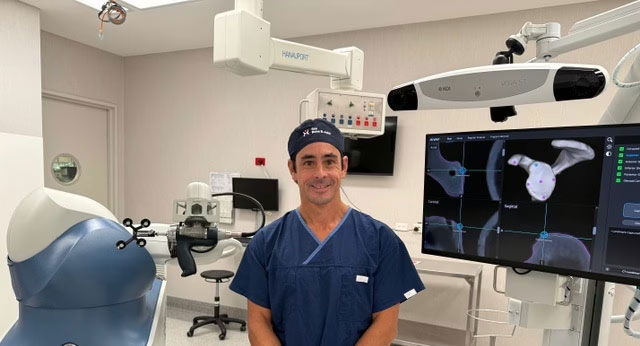
In March 2026, Dr Marcus Chia became the first surgeon in New South Wales to perform a Mako robotic-arm assisted shoulder replacement, at Sydney Adventist Hospital in Wahroonga.
Shoulder replacement surgery has taken a significant step forward with the arrival of Mako SmartRobotics™ — a robotic-arm assisted surgical system from Stryker that brings computer-guided precision to shoulder arthroplasty. Dr Marcus Chia performed the first Mako robotic shoulder replacement in New South Wales at Sydney Adventist Hospital (The San) in Wahroonga in April 2026, making Sydney’s North Shore the first region in NSW to offer this technology for shoulder surgery. The same system has been used in millions of successful hip and knee replacement procedures worldwide, and its extension to the shoulder represents a meaningful advance in implant accuracy, soft tissue protection, and patient outcomes.
What is Mako robotic-arm assisted shoulder replacement?
The Mako SmartRobotics™ system, developed by Stryker, is a robotic-arm assisted surgical platform that combines three-dimensional CT-based pre-operative planning with real-time robotic guidance during surgery. It has been extensively used for hip and knee arthroplasty, with strong evidence for improved implant positioning and long-term outcomes. Its introduction to shoulder surgery represents the next frontier for this proven technology.
The system does not replace the surgeon — it augments their precision. Dr Chia controls the robotic arm throughout the procedure; the system provides real-time feedback and physical boundaries that keep every cut and placement within the pre-planned parameters. The result is a degree of accuracy that would be difficult to achieve consistently by hand alone.
How it works: the three-stage process
Pre-operative 3D CT planning — a CT scan of the patient’s shoulder is taken before surgery and used to create a precise three-dimensional virtual model of their unique anatomy. Dr Chia uses this model to plan the exact size, position, and orientation of the implant components before entering the operating theatre. Every element of the surgical plan — implant type, depth, angle, and alignment — is determined in advance from the patient’s own anatomy.
Real-time robotic guidance during surgery — once in theatre, the Mako system continuously tracks the position of the patient’s shoulder bones in three dimensions. As Dr Chia works, the system compares the real-time position to the pre-operative plan and guides the robotic arm accordingly. If any movement would deviate from the planned boundaries, the system provides haptic (physical) feedback — a resistance that prevents the surgeon from cutting outside the defined safe zone.
Accurate implant positioning and soft tissue protection — the combination of pre-operative planning and real-time guidance allows the implant to be seated in precisely the planned position, protecting healthy bone and surrounding soft tissue. The glenoid (socket) component in particular — historically the most technically challenging part of shoulder replacement — benefits significantly from this level of precision.
Why does implant positioning matter so much in shoulder replacement?
In shoulder arthroplasty, small errors in implant positioning have disproportionately large consequences.
- Glenoid component malpositioning is the leading cause of shoulder replacement failure — loose glenoid components account for the majority of revision surgeries
- Version errors (incorrect rotational alignment of the implant) alter joint mechanics, reduce range of motion, and accelerate implant wear
- Incorrect implant height can alter the length-tension relationship of the rotator cuff and deltoid muscles, causing pain or instability
Potential benefits of robotic-arm assisted shoulder replacement
The Mako system has been used in millions of hip and knee procedures worldwide, with strong evidence supporting improved positioning accuracy. Its application to shoulder surgery is newer, and long-term shoulder-specific data continues to accumulate. The potential benefits — consistent with the evidence from hip and knee use and with Dr Chia’s direct experience from performing NSW’s first case — include:
- Greater implant positioning accuracy — the CT-guided planning and robotic guidance ensure the glenoid and humeral components are placed in the pre-planned position with a level of consistency that exceeds conventional manual technique
- Improved joint stability and function — accurately positioned implants restore normal joint mechanics, contributing to better range of motion and functional outcomes
- Protection of healthy bone and soft tissue — the haptic boundary system prevents inadvertent cuts or contact outside the planned zone, protecting surrounding structures
- Reduced post-operative pain — precise surgery with minimal unplanned tissue disruption is associated with less post-operative inflammation and pain • Faster, more confident recovery — patients who experience less post-operative pain and whose joint mechanics are immediately well-restored tend to progress through rehabilitation more quickly
- Potentially longer implant longevity — accurately positioned implants distribute load more evenly across the joint surfaces, reducing wear rates and the risk of premature loosening
As Dr Chia stated at the time of the NSW-first procedure: “Robotic-arm assisted shoulder replacement may offer improved joint stability, function and range of motion, along with reduced postoperative pain and faster recovery, supporting a more confident return to everyday activities.”
Who is suitable for robotic shoulder replacement?
The Mako system is currently only used for reverse shoulder replacement. The indications for surgery are the same as for conventional shoulder replacement — the robot assists with the execution of the surgery, not the decision to proceed.
Conditions treated with Mako robotic shoulder replacement
- Glenohumeral osteoarthritis — the most common indication. End-stage arthritic degeneration of the shoulder joint that has not responded to conservative management.
- Rotator cuff tear arthropathy — severe shoulder arthritis developing from a large, long-standing rotator cuff tear. Managed with reverse shoulder replacement.
- Fracture — complex proximal humerus fractures (3- and 4- part, head split, fracture dislocations) where tuberosity healing is unreliable.
- Rheumatoid arthritis — inflammatory arthritis causing progressive shoulder joint destruction.
- Post-traumatic arthritis — arthritis developing after previous shoulder fracture, dislocation, or surgery.
- Avascular necrosis of the humeral head — bone death from disrupted blood supply, causing collapse of the humeral head.
- Failed conventional shoulder replacement — revision arthroplasty where the Mako’s 3D planning can be particularly valuable in characterising residual bone stock and planning component positioning.
Who may not be suitable Not every patient requiring shoulder replacement is a candidate for robotic-assisted technique — the assessment is individual and takes into account bone quality, prior surgery, implant availability, and other clinical factors. Dr Chia will advise whether robotic-assisted or conventional arthroplasty is most appropriate for your specific anatomy and diagnosis.
Mako robotic vs conventional shoulder replacement — what is the difference for the patient?
From a patient’s perspective, the experience of robotic-assisted shoulder replacement is very similar to conventional shoulder replacement. The key differences are in what happens in the operating theatre and the quality of the surgical output:
| Conventional shoulder replacement | Mako robotic-arm assisted | |
|---|---|---|
| Pre-operative planning | Standard X-ray templating | 3D CT-based virtual surgical plan; exact implant sizing and positioning pre-determined |
| Intraoperative guidance | Surgeon uses manual instruments and visual landmarks | Real-time robotic guidance and haptic feedback boundaries maintain plan accuracy throughout |
| Glenoid positioning | Manual technique; variation between surgeons and cases | Computer-guided to planned position consistently |
| Bone and soft tissue protection | Surgeon judgment | Haptic system physically prevents deviation outside planned boundaries |
| Patient experience | Same anaesthesia, incision, and hospital stay | Same anaesthesia, incision, and hospital stay |
| Recovery timeline | Standard shoulder replacement recovery | Potentially faster due to reduced tissue disruption and accurate mechanics |
| Availability in NSW | Widely available | Currently available at Sydney Adventist Hospital, Wahroonga (first in NSW) |
Sydney Adventist Hospital — where this procedure is performed
Dr Chia performs Mako robotic shoulder replacement at Sydney Adventist Hospital — known as ‘The San’ — in Wahroonga. The San is one of Sydney’s most respected private hospitals, with a long history of investing in advanced surgical technology and a specialist orthopaedic theatre suite equipped for complex joint arthroplasty.
Sydney Adventist Hospital is also the location where Dr Chia conducted NSW’s first Mako robotic shoulder replacement in April 2026. It is also one of three hospitals where Dr Chia performs surgery — alongside Northern Beaches Hospital (Frenchs Forest) and Wyvern Private Hospital (Terrey Hills). Northern Beaches Hospital holds accreditation as a Centre of Excellence in Orthopaedic Surgery from the Surgical Review Corporation (2024–2027).
What to expect: before, during, and after robotic shoulder replacement
Before surgery
- Specialist consultation with Dr Chia — including a thorough assessment of your shoulder, review of X-rays, and recommendation of whether robotic-assisted or conventional replacement is most appropriate
- CT scan of the shoulder — taken specifically for Mako pre-operative planning; the scan creates the 3D virtual model that Dr Chia uses to plan your implant position before the day of surgery
- Virtual surgical planning review — Dr Chia reviews and finalises the 3D plan, selecting implant sizes and confirming placement parameters
- Pre-operative preparation — as for all shoulder replacement surgery; see the Before Your Surgery page for details
On the day of surgery
- General anaesthesia combined with an interscalene nerve block for post-operative pain control
- The procedure itself is performed through the same approach as conventional shoulder replacement — a deltopectoral incision at the front of the shoulder
- The Mako system is used throughout the bone preparation and component positioning stages, guided by the CT-based pre-operative plan
- Operative time is similar to conventional shoulder replacement: typically 1–2 hours
- Most patients stay in hospital for 1–2 nights
Recovery Recovery from Mako robotic shoulder replacement follows the same staged protocol as conventional shoulder replacement:
| Timeframe | Recovery milestones |
|---|---|
| 0–6 weeks | Arm in a sling. Passive range of motion exercises guided by physiotherapist. Protecting the subscapularis repair is the priority. |
| 6–12 weeks | Sling removed. Active-assisted range of motion. Light daily activities resume. |
| 3–4 months | Active strengthening programme. Return to driving and desk work for most patients. |
| 4–6 months | Return to recreational activities — golf, cycling, swimming. |
| 6–12 months | Full recovery for most patients. Final range of motion and strength established. |
Dr Marcus Chia — experience and credentials in shoulder arthroplasty
Robotic-assisted surgery demands a surgeon who is not only familiar with the technology but also has the deep clinical foundation to interpret the 3D planning, make intraoperative judgements, and manage the full complexity of shoulder arthroplasty. Performing NSW’s first case requires both.
- First surgeon to perform Mako robotic shoulder replacement in New South Wales — Sydney Adventist Hospital, April 2026
- Fellowship-trained exclusively in shoulder and elbow surgery — not a generalist
- Advanced training in shoulder arthroplasty through subspecialty fellowships at the Alps Surgery Institute in Annecy, France (under Dr Laurent Lafosse) and Cleveland Clinic, USA (under Dr Joseph Iannotti).
- Performs both total (anatomic) and reverse shoulder replacement with conventional, PSI (patient specific instrumentation) and robotic-assisted technique
- FRACS (Orthopaedics), FAOrthA, MBBS (Hons), BAppSc (Physiotherapy) — University of Sydney
- Sydney Adventist Hospital (Wahroonga) is an SRC-listed centre with a fully equipped joint arthroplasty theatre suite
Frequently asked questions about Mako robotic shoulder replacement
Mako robotic shoulder replacement uses the Mako SmartRobotics™ system from Stryker to assist the surgeon with highly accurate implant positioning during shoulder arthroplasty. Before surgery, a CT scan of the patient's shoulder is used to create a 3D virtual plan. During surgery, the robotic arm guides the surgeon's movements in real time, providing physical resistance if any cut or placement would deviate outside the planned safe zone. The result is more consistent implant positioning than conventional manual technique, with the potential for improved joint function, reduced pain, and faster recovery.
Is Mako robotic shoulder replacement available in Sydney?Yes. As of April 2026, Mako robotic-arm assisted shoulder replacement is available in NSW for the first time, at Sydney Adventist Hospital (The San) in Wahroonga. Dr Marcus Chia performed the first Mako robotic shoulder replacement in New South Wales at The San in March 2026. Patients on Sydney's North Shore and Northern Beaches can access this technology through Dr Chia's practice.
Does the robot perform the surgery, or does the surgeon?The surgeon performs the surgery. The Mako system is a robotic arm that Dr Chia controls throughout the procedure. It provides real-time guidance and physical boundaries that help maintain the precision of the pre-operative plan — but the surgical decision-making, the approach, and the execution are performed by Dr Chia. The robot augments surgical precision; it does not replace clinical expertise or surgical judgment.
Do I need a CT scan before robotic shoulder replacement?Yes. A CT scan is required before Mako robotic shoulder replacement to generate the 3D virtual model of your shoulder anatomy. Dr Chia uses this model to plan the exact implant size, position, and orientation before surgery. This pre-operative planning is one of the key advantages of the robotic system — it allows the surgical plan to be completely individualised to your unique anatomy before you enter the operating theatre.
Will I recover faster after robotic shoulder replacement compared to conventional replacement?The evidence from Mako hip and knee replacement suggests that the more accurate implant positioning and reduced soft tissue disruption associated with robotic assistance may support faster recovery and a more confident return to daily activities. In shoulder arthroplasty, longer-term data is still accumulating, but the same principles apply. The recovery protocol — sling, physiotherapy, and graduated return to activity — is the same as for conventional shoulder replacement, and most patients achieve their final functional outcome at 6–12 months.
Is Mako robotic shoulder replacement suitable for total shoulder replacement (anatomic) as well as reverse shoulder replacement?No. The Mako system is currently only available for reverse shoulder replacement. The 3D CT planning is applicable to both implant types. Dr Chia will advise which type of replacement is appropriate for your diagnosis and anatomy.
Is Mako robotic shoulder replacement covered by Medicare and private health insurance?The surgical procedure — shoulder arthroplasty — is a recognised MBS procedure and attracts a Medicare rebate. With appropriate private health insurance (typically Gold cover for joint replacement), the procedure is covered. The robotic technology is part of the surgical facility's equipment and does not generate a separate out-of-pocket charge. Out-of-pocket costs depend on your insurer and level of cover. Dr Chia's rooms can provide a detailed fee quote.
How do I know if I need shoulder replacement at all?Shoulder replacement is considered when shoulder arthritis causes significant pain and functional limitation that has not responded to conservative management — including physiotherapy, anti-inflammatory medication, and intra-articular injection. It is not a first-line treatment. Dr Chia takes a genuinely conservative approach and will recommend shoulder replacement only when it is clearly the most appropriate next step for your specific situation. If you are unsure whether you need replacement surgery, a specialist consultation is the right starting point.
Book a consultation
If you have been told you may need shoulder replacement, or if you would like to discuss whether Mako robotic shoulder replacement is appropriate for your condition, Dr Chia provides a thorough specialist assessment at four consultation locations across Sydney’s North Shore and Northern Beaches.
Call: (02) 8014 4252
Online: Request an appointment
Dr Chia consults at Wahroonga (Sydney Adventist Hospital — where NSW’s first Mako robotic shoulder was performed), Frenchs Forest (Northern Beaches Hospital), Mona Vale, and Terrey Hills (Wyvern Private Hospital).
Any surgical or invasive procedure carries risks. The information provided here is for general educational purposes only. The Mako SmartRobotics™ system is a Stryker product. For specific advice about your shoulder condition and surgical options, please consult Dr Marcus Chia directly.
For appointments and enquiries, please phone (02) 8014 4252
Peninsula Orthopaedics
Suite 20, Level 7
Northern Beaches Hospital
105 Frenchs Forest Road
Frenchs Forest NSW 2086
Mona Vale Rooms
Suite 502, 20 Bungan Street
Mona Vale NSW 2103
Northside Orthopaedics
Suite 403, Level 4
San Clinic
Sydney Adventist Hospital
185 Fox Valley Road
Wahroonga NSW 2076
Wyvern Private Hospital
Suite 15, Level 1
33A Myoora Rd
Terrey Hills NSW 2084
There are limited slots available for online bookings. For more appointment options, such as earlier dates/times or urgent appointments, please contact our rooms directly.
